
High candidate interest in healthcare careers is frequently mistaken for expanding clinical capacity. In 2026, application volume and nursing school enrollments sit at decade-high peaks according to standard registered nurse metrics, yet healthcare facility floor vacancies remain stubbornly fixed above eight percent.
For healthcare executives, this disconnect creates a dangerous operational blind spot. Budgeting under the assumption that top-of-funnel applicant interest will naturally alleviate the nursing shortage leaves health systems vulnerable to continuous coverage gaps, escalating overtime expenses, and mandatory agency reliance.
The persistent staffing failure is really not an effort problem, a marketing deficit, or a candidate motivation issue. Rather, domestic clinical supply is governed by four rigid structural ceilings, each locked in a multi-year planning horizon that prevents immediate expansion within standard budget cycles.
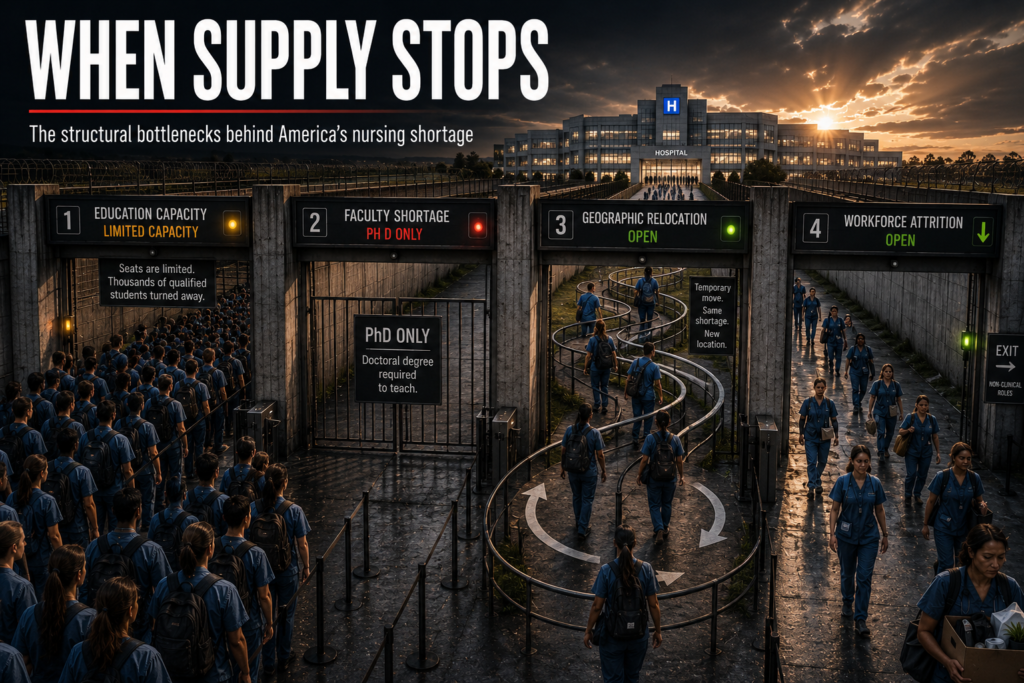
I. The Domestic Nursing Pipeline Bottleneck
Public interest in nursing careers has reached its highest level in over a decade, yet healthcare facilities continue to navigate chronic vacancy rates. Understanding why candidate interest fails to yield floor-ready clinical capacity requires examining the structural barriers operating between nursing school application portals and hospital units.
Candidate Clinician Expansion Fallacy
Bachelor of Science in Nursing BSN enrollment increased by 7.6% in the 2025 to 2026 academic year, adding 19,830 students to the educational pipeline. While this growth reversed a post-pandemic contraction, measuring workforce expansion by enrollment figures alone creates a misleading picture of pipeline health. Candidate demand at the application portal vastly outstrips the physical capacity of academic institutions to seat new students.
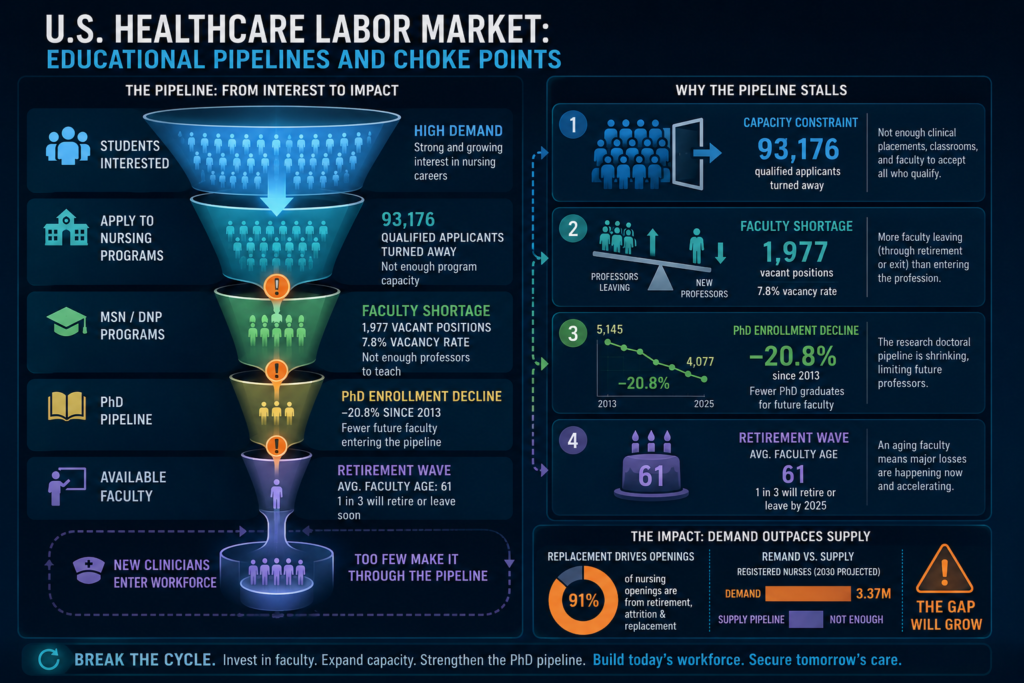
In 2025, United States nursing schools turned away a record 93,176 qualified applications from candidates who satisfied every academic prerequisite. Entry-level BSN programs alone rejected 75,255 qualified applicants due to fixed capacity limits. This total represents a steady escalation from 80,162 rejected applications in 2024 and 65,766 in 2023.
Comparing top-of-funnel applicant interest against seated output capacity exposes the structural bottleneck. Educational institutions turned away nearly five times as many qualified applications as the new BSN seats added to the national system. Rather than candidate disinterest, the nursing shortage stems from an institutional failure to convert qualified applicant demand into enrolled students, demonstrating why relying on DIY healthcare recruiting fails to solve floor vacancies.
Clinical Placement Bottleneck
Given such strong interest in the nursing field, a critical question is why academic institutions do not simply expand enrollment to capture this surging tuition revenue. The answer lies in a rigid legal boundary. State boards of nursing and national accrediting bodies legally prohibit universities from admitting a student without first securing guaranteed clinical placement slots and state-mandated preceptor-to-student supervision ratios.
These clinical placement sites, representing the specialized hospital floors where nursing students complete mandatory direct-patient care hours, serve as the ultimate hard cap on admissions. When health systems trim core staff or operate under chronic vacancies, preceptor bandwidth contracts immediately. This operational efficiency forces hospitals to reduce the number of student rotation slots they can host, legally freezing university admission caps regardless of candidate volume or institutional financial incentive.
Furthermore, physical infrastructure creates a parallel barrier alongside these clinical site limits. Academic institutions face strict physical limits on classroom square footage, simulation lab stations, and high-fidelity training equipment. Without expanded clinical sites and physical lab capacity, nursing programs cannot increase seat counts without compromising accreditation standards or violating statutory board ratios.
The “Multi-Year Horizon” Dead End
The immediate reaction to these physical constraints is to call for rapid capital investment and infrastructure expansion. However, scaling educational infrastructure requires navigating multi-year planning horizons that cannot respond to single-quarter hospital staffing crises. State budget appropriation cycles take years to negotiate and distribute, while physical construction and accreditation reviews move at an equally deliberative pace.
Even when health systems and universities form direct financial partnerships to fund new simulation labs through dedicated workforce partnership models, lead times lock the bottleneck in place. A university that receives expansion funding today requires four to six years to construct facilities, establish clinical rotation agreements, and graduate its first expanded cohort. Consequently, HRSA workforce projections demonstrate that top-of-funnel domestic pipeline expansion remains mathematically fixed across standard operational planning cycles, rendering traditional healthcare hiring processes ineffective at bridging single-quarter gaps.
Regardless, physical infrastructure and clinical placement slots represent only the visible layer of the educational bottleneck. Even if a health system constructs new facilities and opens additional unit rotations tomorrow, a deeper, structural chokepoint prevents those seats from being filled, leaving the nursing shortage intact.
II. The Faculty Chokepoint
The academic cohort, responsible for training the next generation of nurses, is aging out faster than the doctoral pipeline can supply replacements. Assuming an instantaneous expansion of academic and facility placement capacity, structural educator deficits would remain a primary choke point restricting student enrollment across the country.
A Financial Disincentive: The Academic Pay Gap
The national full-time nurse faculty vacancy rate stands at 7.8%, representing nearly 2,000 vacant teaching positions across United States nursing schools. Regional variation is pronounced, peaking in the Western region at 9.8% while remaining lowest in the Midwest at 5.6%. However, no geographic region maintains sufficient faculty density to seat all qualified applicants. One factor critical to the persistence of open faculty positions is financial incentives.
A profound wage disparity drives this faculty deficit. A senior bedside registered nurse with a BSN typically earns $80,000 to $110,000, and up to $140,000 to $160,000 in high-acuity specialties. Conversely, a master’s-prepared nursing instructor at a community college or state university earns up to $85,000 on a nine-month contract, topping out around $115,000 due to fixed state salary bands. An experienced clinician faces a $30,000 to $75,000 pay cut to enter academia, creating an economic penalty that deters prospective educators.
The Structural Shrinkage of Doctoral Pipelines
Even when a clinician is willing to absorb this financial penalty, strict credentialing standards block their entry into the classroom. Approximately 79.8% of vacant nurse faculty roles require or prefer instructors holding terminal doctoral degrees (PhD or DNP). This requirement directly conflicts with prevailing enrollment trends in academic research programs.
Enrollment in research-focused doctoral nursing programs has contracted for eleven consecutive years, dropping by more than 20% since 2013. The academic pipeline is failing to produce the doctorally prepared educators required to train future undergraduate cohorts. This creates a self-reinforcing contraction where a shrinking faculty pool restricts BSN enrollments, further narrowing the future pool of prospective doctoral candidates.
The Human Toll of an Aging Professoriate
Finally, while the incoming doctoral pipeline shrinks, the active professoriate is retiring at an unprecedented rate. The average age of full professors in nursing schools is 61.2 years, associate professors average 55.6 years, and assistant professors average 49.6 years. The professoriate is past traditional retirement age, while associate professors sit within a decade of exit.
Furthermore, 2015 projections indicating that one-third of the active nursing faculty workforce would leave academia by 2025 have fully materialized. As senior faculty retire, institutions struggle to recruit replacement instructors from the shrinking doctoral pool. Without a foundation to train new clinicians to match demand, the nursing shortage is likely to persist.
III. An Aging Nursing Workforce Worsening the Nursing Shortage
Like the faculty cohort, the practicing bedside workforce is exiting direct patient care at a rate that outpaces domestic graduation numbers. This exit velocity creates an operational deficit that standard recruitment metrics often fail to capture.
The Clinician Exit Velocity
The median age of registered nurses in the United States sits between 50 and 52 years, with nearly 25% of all active clinicians aged 55 or older. Survey data reveals that approximately 40% of practicing nurses plan to retire or exit clinical practice within the next five years, making compliance with state-level CMS staffing requirements increasingly difficult to sustain and exposing facilities to the worst consequences of nursing shortages.
This demographic transition creates an unfavorable replacement equation. Even if domestic nursing schools operated at maximum capacity, annual graduation counts cannot keep pace with the volume of retiring clinicians. Facilities that deploy strategic recruitment and retention strategies can minimize the impact of the nursing shortage, but the broader exit velocity of experienced staff continues to exceed the entry velocity of new graduates.
The Ripple Effect of Invisible Bedside Flight
Macro workforce metrics often create a false sense of security for healthcare executives by tracking active state licenses rather than active bedside hours. Data indicates that 43% of practicing nurses express a high likelihood of leaving bedside clinical care within twelve months, while 23% plan to leave the nursing profession entirely. This widespread departure intent stems directly from workload strain, unsafe staffing ratios, and clinician turnover dynamics.
Crucially, 16% of nurses leaving the bedside transition into non-clinical roles such as case management, utilization review, and insurance administration. In fact, up to 71% of case management personnel originally exited direct patient care roles. Because these clinicians retain active state licenses, standard licensing board statistics obscure the loss of direct patient care capacity. The health system absorbs the loss of floor coverage while macro statistics report stable nurse totals.
The International Queue Constraint
When domestic supply ceilings and invisible bedside flight exhaust local talent pools, healthcare executives logically pivot to international recruitment to survive the nursing shortage and stabilize clinical operations. Facilities typically pursue two distinct immigration mechanisms: fast-track temporary status like USMCA TN visas, and traditional permanent residency pathways like EB-3 immigrant visas. While TN visas allow rapid entry for Canadian and Mexican clinicians without statutory caps, their strict geographic limitation prevents them from scaling to meet national demand.
Consequently, health systems relying on the broader global supply chain must navigate the EB-3 pathway, which faces a 140,000 annual statutory cap across all employment preference categories alongside a rigid 7% per-country limit. For high-volume source countries, severe Visa Bulletin retrogression extends total processing timelines to approximately 30 months from initial petition to bedside arrival. While international pipelines offer essential multi-year workforce stability, navigating healthcare staffing compliance across regulatory queues prevents them from solving acute single-quarter vacancies.
IV. Geographic Reallocation, Not Pipeline Growth
Beyond the absolute domestic skills supply failure, the fourth mechanism driving local nursing shortages is a geographic distribution failure driven by shifting economic incentives. Clinicians are increasingly reallocating across geographic markets based on cost-of-living metrics and stipend structures.
The “GSA Stipend Arbitrage” Mechanism
Healthcare executives frequently rely on contingent travel nursing as an immediate temporary fix for acute unit vacancies. However, over-relying on temporary flexible staffing models mistakes labor redistribution for actual workforce expansion. Contingent agency contracts do not generate net-new clinical capacity; they merely shift a static pool of existing clinicians across geographic markets based on tax-free profit margins.
This geographic movement is powered by tax-free lodging and meal allowances governed by General Services Administration (GSA) per diem rates. Clinicians who maintain a permanent tax home receive these tax-free stipends to cover temporary living expenses during clinical assignments. Under favorable market conditions, agency nurses maximize their take-home compensation by securing low-cost housing well below the federal per diem ceiling.
For example, 2026 GSA lodging allowances in high-demand states range from $110 to $436 per night depending on location and season. Securing accommodation at $50 per day below the federal allowance generates an $18,000 annual tax-free cash surplus. Health systems seeking long-term stability must pivot toward permanent healthcare staffing solutions rather than enabling continuous stipend arbitrage that moves existing labor between facilities without adding a single nurse to the national pool.
High-Cost Metro Surplus Compression
Recent inflationary shifts have severely compressed the tax-free stipend margin in major metropolitan centers. High-cost urban markets such as Boston, San Francisco, and New York have experienced significant housing cost inflation, with regional shelter indices rising 3.4% year-over-year.
Short-term furnished housing platforms responded by adjusting weekly rental rates upward to match maximum federal per diem ceilings. Consequently, the tax-free housing surplus that previously attracted travel clinicians to urban health systems has been eliminated. Stripped of their financial margin, travel nurses increasingly reject contracts in primary metropolitan markets, transforming urban assignments from high-yield opportunities into financial shortfalls.
The Reallocation Premium on Safety-Net Budgets
This economic shift has triggered a geographic reallocation of contingent labor. Rather than accepting contracts in high-cost urban centers, agency nurses are opting for secondary and rural markets where lower living costs preserve their stipend surplus.
This movement leaves metropolitan safety-net hospitals facing acute staffing deficits without an increase in overall national nurse supply. To recruit clinicians back into high-cost urban centers, staffing agencies must raise hourly bill rates, forcing safety-net facilities to absorb higher agency staffing costs. This ongoing surge in contract labor directly degrades patient satisfaction and overall healthcare reputation management, forcing urban facilities to pay a steep reallocation premium for the exact same clinical labor.
Conclusion: A Nursing Shortage Here to Stay
The four mechanisms driving the supply failure and perpetuating the nursing shortage:
- Domestic educational limits,
- Faculty vacancies,
- Bedside attrition & an inadequate international pipeline, and
- Geographic reallocation,
are interconnected elements of a single structural challenge.
Local, reactive hiring strategies cannot overcome fixed national capacity ceilings or multi-year academic expansion timelines. Facilities that rely on temporary fixes will continue to absorb rising premium labor costs without resolving their underlying operational volatility. To transition from reactive coverage to sustainable, relational healthcare staffing, healthcare leaders must address structural pipeline constraints directly.
For why the cost drivers in the 2026 recruitment budget are moving up in parallel with the nursing shortage, and what the structural alternative looks like, see the full analysis at navahc.com