
The resignation of a key figure in any organization can be inconvenient at best, devastating at worst. In the US healthcare market, the resignation of a senior ICU nurse, the one who has precepted every traveler this year, whose name is on the rapid-response binder, initiates an economic cost cycle that traditional hospital ledger systems are structurally unequipped to capture.
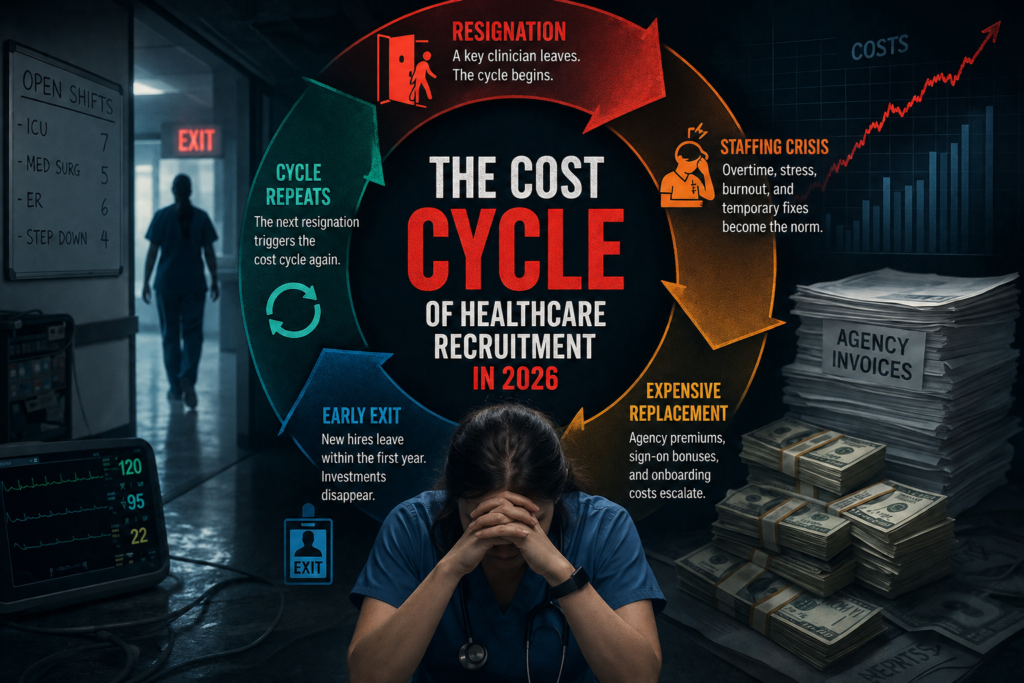
CFOs frequently treat recruitment as a series of isolated, transactional line items: agency fees, sign-on bonuses, and onboarding hours. In reality, healthcare recruitment in 2026 functions as a single, compounding cost loop that begins at the separation event and terminates only when systemic friction triggers the next resignation. Understanding this cost cycle requires moving beyond isolated ledger columns to map the true clinical and financial velocity of clinician turnover.
The Anatomy of the Separation Event
When a resignation letter lands on a leader’s desk, it will hardly ever state that this is about money. And, unless the decision-maker is familiar with the personal circumstances surrounding the departing employee, they will almost always conclude that, despite whatever reason is declared, it really is about the money. However, due to staffing shortages across the US, there are always standing offers for highly talented clinicians, and by the time they resign, it really may not be about the money.
Early Clinician Turnover: The Anatomy of a Quick Resignation
Early clinician turnover (resignation within the first 12 months) is a negative ROI event. Everything invested in sourcing, screening, credentialing, onboarding, and preparing that individual for productivity walks out the door with them and must now be repeated, hopefully with the right candidate this time.
The full anatomy of an early clinician turnover runs through three distinct, diagnosable buckets:
- The Uncontrollable (a spousal interstate transfer or a family crisis that no compensation can prevent),
- The Transactional (better offers, a misfit between the new hire and the unit or environment), and
- The Systemic (rigid staffing ratios, mandatory overtime, and denied PTO that signal the organization values policy compliance over human sustainability).
Voluntary terminations account for 95.4% of early clinician turnover, meaning the vast majority of exits are choices, not accidents of fate. Considering that a new appointee joins on a freshly negotiated contract, it is highly unlikely that the leading trigger was related to remuneration. Rather, 72% of new hires experience “Shift Shock”, the glaring disparity between the job description a candidate was sold and the reality on the floor. As a result, the newly appointed clinician, after failing to adjust to their new environment, rejects the unit or the unit rejects them. This is not the case with experienced permanent staff resignations.
Tenured Clinician Turnover: The Wage Signal, the Unstable Team, the Burnout
While 78% of healthcare executives believe staff leave due to a lack of flexibility, 75% of nurses cite pay and unsafe staffing, a disconnect that produces ineffective retention strategies. Agency nurses earned between 151% and 287% of the weekly pay of regular direct care nurses during the height of the COVID-19 pandemic. Even in the post-pandemic market, travelers often earn significantly more than permanent staff.
The same dollar that fills a vacancy signals to the permanent staff that the contingent rate is the real market, and the calculation becomes straightforward. A senior nurse who has been at $80 per hour for three years, now noticing an agency rate $25 per hour above their own wage, makes the resignation a rational economic decision at the individual level.
Moreover, the agency churn produces unstable teams and burnout on the unit floor. Every time a new 13-week traveler arrives, experienced nurses spend the initial two to four weeks in a coaching posture, and the permanent staff nurse overseeing them experiences a productivity drag because they must validate the traveler’s adherence to facility-specific safety standards. A resentment tax is levied when permanent nurses report feeling “unworthy and underappreciated”, watching the travelers they teach earn significantly more for the same work. That perception of organizational injustice is a primary driver of burnout and turnover intentions among the permanent staff, creating a secondary wave of turnover. These personal grievances are not contained to staff discontent; they translate into organizational financial liabilities.
Per-Separation Cost: No Longer Insignificant
The per-separation costs may be the visible line items directly associated with a resignation, but they are far from being the main contributor to organizational loss. Still, these are significant contributors to the cost cycle of healthcare recruitment. Exit administrative costs can be up to $1,000 per departure, while direct talent acquisition costs, including recruiter fees, advertising, and candidate screening, run up to $13,500 per hire.
Beyond the recruiting fees themselves, the facility pays a sign-on bonus that has become a baseline expectation in most permanent RN offers, reaching an average of $18,400 across 127 hospitals in the first quarter of 2026. This is a significant jump, considering that as recently as 2010, these bonuses were for niche or selective positions. The timeline is as follows:
| Year | Entry-Level/General RN Bonus | High-Acuity Specialty RN Bonus | Market Characteristics |
| 2010 | Selective / niche only | Selective / niche only | Limited niche use only |
| 2015 | $2,000 | $5,000 – $10,000 | Emergence as a mainstream recruitment tool |
| 2019 | $8,000 | $16,000 | Pre-pandemic clinical supply pressures |
| 2022 | $12,500 | $25,000 | Peak pandemic labor competition |
| 2024 | $10,000 – $15,000 | $20,000 – $25,000 | Persistent core clinical vacancies |
| 2026- | $25,000 | $40,000 | Heightened shift-specific targeted capital |
Lastly, the talent acquisition cost includes credentialing, which the facility absorbs separately. Credentialing specialists spend 20-30 hours per application. Background checks cost $50-$250, license verification costs $40-$100, and board certification costs up to $395 per provider. Spending $400 on the paperwork to get your newly-appointed employee cleared for duty is rightfully considered just the cost of doing business; however, the costs compound if your HR is filling the same role multiple times each year and spending countless hours on screening and credentialing, rather than the HR functions that improve the well-being of your floor staff.
The separation and talent acquisition costs, collectively, are quite considerable and can be tracked easily on financial statements. However, they are just a portion of the full cost of a resignation. Your replacement clinician is not arriving within 24 hours of that departure. In fact, the average time-to-fill for a registered nurse (RN) is 78 days. Until that new assignment is onboarded, facilities have a gap to fill.
The Short-Staffed Game of Survival
The weeks following a resignation are the coverage scramble, the Hunger Games of clinical care. A clinical care clock starts ticking, and healthcare leaders are none the wiser to the full ramifications of ignoring it. The unit managers will make it clear that a quick replacement is critical to prevent their units from catching fire, but the decision-makers respond better to line items that appear on financial reports. These do not.
Overtime Absorbs the Vacancy First
Before a replacement lands, the permanent staff absorbs the vacancy through overtime. The premium is 1.5x base for hours over 40 in a workweek, but the structural cost is the burnout rate. Facilities may be forced to implement mandatory overtime, which has a direct correlation with burnout and subsequent voluntary separations. As a temporary measure, it works; however, floor hour limits, considering that the standard work week consists of three 12-hour shifts or four 10-hour shifts. Any more than that leaves clinical staff susceptible to preventable medical errors.
The Ticking Clinical, Financial, and Reputational Clocks
The resignation of key personnel triggers a countdown to the degradation of clinical care. A 2024 JAMA Network Open study by Griffiths et al. found that a 10% increase in temporary RN staffing was associated with a 2.3% increase in patient mortality, with the mechanism of harm likely the lack of familiarity with the micro-system. The new hire does not know where the code cart is, who to page for a rapid response, or the subtle nuances of team communication. Units with high agency reliance see a 4% increase in unit-acquired pressure ulcers, and the 60.2% of older patients who experience functional decline within 90 days of an emergency department visit is a metric highly sensitive to the quality of care transitions, the transitions that agency nurses handle during a 13-week contract.
In a domino effect, that same resignation triggers a financial clock via Hospital Value-Based Purchasing (VBP) and reputational damage. Up to 2% of Medicare reimbursement is withheld annually based on a composite score that includes clinical outcomes, safety metrics, and patient-experience measures, and the patient-experience instrument that feeds the VBP score is the HCAHPS survey (Hospital Consumer Assessment of Healthcare Providers and Systems). A short-staffed unit, where burned-out nurses manage higher patient loads and rotate through 13-week travelers, scores lower on the HCAHPS nurse-communication, responsiveness, and care-transition sub-scores. Beyond this direct penalty, patient dissatisfaction can be shared via social media and other channels, eroding a facility’s consumer-facing reputation and its ability to attract new patients. But patients are not the only ones who can use the internet.
Clinicians are increasingly active on platforms such as Reddit and Facebook. Sure, wages vary by geography; this is not news. What matters to clinicians, what they spend time discussing, are their work experiences. Understaffing and exposing clinicians to burnout can trigger a facility’s brand degradation online, reducing its ability to attract and retain talent, and creating a negative feedback loop.
“A nursing student … decided not to apply for bedside roles after graduation. Not because of her clinical rotations. Not because of faculty advice. Because of what she sees every night on TikTok. Her feed is filled with short videos describing unsafe staffing, emotional exhaustion, hostile workplaces, and nurses counting down the days until they can leave the profession.”
(Source: Journal of Advanced Nursing Practice)
After a single key resignation, the clinical, the financial, and the reputational preservation clocks all count down to the same beat.
The Agency Bill Rate Compounds the Cost
When overtime saturates, the hospital turns to temporary staffing agencies, and the agency’s bill rate compounds the cost. Hospitals paid an average of $90.54 per hour to staffing agencies for travel nurses in 2026, down from a 2022 pandemic peak of $133.47 per hour but still 39.3% above the 2019 baseline of $65.00 per hour. The agency markup embedded in that rate is typically 25-40%, meaning $22 to $36 of every hour billed goes to the agency rather than the clinician. Some markets see markup multipliers as high as 1.500x, where a facility pays 150% of the clinician’s base wage, per state procurement data. Exacerbating the additional financial burden on the institution are the permanent staff who then wonder why the hospital cannot match the agency bills when it comes to paying the people that keep the facility running, when the travellers depart before resigning themselves.
Predictably, the 2026 market has stabilized at a structurally elevated level. The travel nursing sector is projected to hold a $14.3 billion revenue baseline in 2026, down 20.6% from the 2024 peak of $18 billion but well above the pre-pandemic norm. The stability is not a return to baseline. The stability is a new floor. For a position running 1,872 hours per year at $90.54, the annual bill is $169,490. The calculable markup component is $42,000-$67,000 of that bill; the incalculable is the impact of the resignations that follow. In light of this evidence, one would think that the most prudent move for any facility would be to restrict agency use.
The Agency Share and the Conversion Fee
The agency’s share of total hospital nursing labor expense peaked at 39% in 2022, up from 5% in 2019, and the post-pandemic correction has brought the share down to approximately 12-15% in 2026. That share is still two to three times the pre-pandemic baseline, and the dollars have not come back to the hospital. So, facilities still have relatively high agency usage and continue to pay high premiums. There is one exit pathway offered by agencies to convert their nurses to permanent placement, but that requires a significant capital investment.
When the facility tries to convert a known-fit agency nurse to permanent status, the agency contract imposes a conversion fee of 15-25% of the nurse’s first-year salary. With the average annual staff RN salary at $86,000, the typical fee lands at $17,000 per conversion. Three states have moved to restrict or pro-rate these fees: Iowa, effective July 2022; Louisiana, effective August 2022; and Oregon, effective July 2023. California courts have increasingly ruled that non-solicitation provisions in staffing contracts are unenforceable under Business and Professions Code section 16600. Ideally, conversion fees should be abolished as they are unearned income rather than reimbursement for a service.
The days between a key staffer handing in a resignation and their replacement walking in are about survival. A resignation creates a gap in your floor units, which you may temporarily cover with overtime, but not for too long, because that will create burnout and trigger another resignation. So you hire agency nurses, but hopefully not for too long, because that puts financial strain on your budget for talent acquisition. Plus, some side-eyes from your floor staff is helping them realise that they can make more if they resign and join an agency, leaving a gap in your floor units you could cover with overtime, but not for too long. Welcome to the Hunger Games. But the tournament doesn’t end just because your newly-hired clinician just walked through the doors.
Post-Hire Economics: Onboarding and Integration
Day 1 on the floor for your replacement nurse marks an important milestone in the recruitment journey. While the new arrival might elicit sighs of relief from the boardroom, it marks the beginning of the most deceptively volatile period in the process, during which your efforts to survive a key departure could be undermined.
Onboarding
The induction of your new recruit starts with onboarding, and the all-in cost to onboard a replacement RN totals roughly $23,000 per hire, including orientation, facility-specific training (including materials, lab time, and mandatory modules), preceptor and program director hours, licensing, and compliance. For specialty nurses (ICU, OR, ER), the replacement cost can reach $124,600. Travel nurses are oriented faster, typically 1-2 days versus 2 weeks to 6 months for permanent staff, at an internal cost of $3,000 to $5,000 per arrival, but the frequency of arrival is the multiplier. A position that cycles through four 13-week travelers per year pays the orientation cost four times.
The Preceptor Drag and the First-Error Spike
Every newly hired RN completes a 6-12 week clinical preceptorship under a senior bedside nurse. During the preceptorship, the senior nurse’s clinical capacity drops by approximately 50% while validating the new hire’s adherence to facility-specific safety standards. The new hire operates at less than 60% of an experienced clinician’s productivity. The dollar cost of that drag averages approximately $7,000 per hire in 2026, up from $5,000 in 2019, tracking the rise in senior RN wages rather than any change in preceptorship duration.
Moreover, the first 3-4 weeks of a new contract are the highest-error window. Medication errors, charting mistakes, and miscommunication during rapid response events all spike in the first three to four weeks of a new contract, not because the new hire is incompetent, but because clinical practice requires localized knowledge that cannot be transported from one assignment to the next. It’s an unavoidable aspect of a new hire, but the rates of incidents are compounded if the preceptors are already overworked and on the edge of burnout. Not to mention if the same preceptors are constantly required to go through the same training cycles multiple times per year for temporary hires that leave after a few months, it becomes challenging to fully invest in the success of their trainee. Consequential as error spikes are, they pale against the consequences of shift shock.
The First-Year Flight and the Pay-Twice Cost Cycle
After investing in job advertisement, screening, credentialing, onboarding, preceptorship, licensing, and paying out part of the sign-on bonus, the new hire that was supposed to solve all the problems can still walk out the door early and leave a unit back on square one. Domestic first-year flight runs between 22.7% and 29% of new hires, per NSI 2026, and accounts for 29% of all RN separations. For domestic hires, the first-year attrition rate is the single largest multiplier of the per-separation cost. A hospital that onboarded a new nurse in January pays separation, vacancy coverage, and onboarding for the same position by November if the new hire is in the 22.7-29% who leave.
Fundamentally, the failure to hold on to newly acquired talent is the ultimate Uno-reverse card that aggregates and compounds all the costs associated with healthcare recruitment. The facility pays the per-separation cost, the vacancy coverage, and the onboarding cycle for the same position twice within the same fiscal year when the new hire is in the cohort that leaves. This highlights the importance of hiring with cultural and character fit in mind. No number of hours spent studying CVs or devising a series of elaborate interviews can hedge against hiring a misfit. They may look good on paper and say all the right things in the interview, but still leave anyway.
Over the past five years, the average hospital has turned over 102% of its entire RN workforce, and the 2025 annual turnover rate ticked back up to 17.6% from 16.4% the prior year. The 102% over five years is the cost cycle’s cumulative footprint. The 17.6% per year is the cycle’s annual velocity. This is why relationship-driven recruitment, a systematic approach that goes beyond the certifications and credentialing and understands the human behind the clinician, is still the best approach.
Closing: A Cycle With a Different Path
Healthcare recruitment is increasingly expensive in 2026. The cost drivers discussed in this article explain why the costs are this high. In any other industry, a skill shortage is self-correcting. If there is a shortage of lawyers or accountants, high school students flock to law and accounting schools upon graduation. If there is a data boom and a strong demand for data engineers, the computer sciences faculty grows overnight. But this is not the case with nursing science. The interest from prospective students is stronger than ever, but the capacity to register them in the faculty has flatlined and could potentially shrink.
We explore the reasons why tertiary institutions are failing to train enough clinicians to cover demand, and why it will take multiple generations of students before we can expand capacity in the next article. Still, it is worth remembering that this domestic recruitment cost cycle is not the only path. International recruitment, built around retention by design through 3-year employment commitments and cohort integration, runs the cycle at a different rate. At least for now, retention-focused recruitment and international pipeline are the most viable channels that break the cost cycle’s structural floor.
This is a companion deep-dive article for a cross-sectional study investigating how and why healthcare recruitment became disproportionately expensive in the US, and why this trend is likely to persist without deliberate intervention. Read the full analysis at navahc.com.