
Financial evaluations of contingent labor in healthcare (agency nurses) consistently focus on hourly premiums. Travel nurse bill rates averaging $89.78 to $93.81 per hour against permanent staff loaded costs of $55.79 per hour represent a 68% markup on the line item, which is what shows up in the budget. Agencies extract significant operating capital through 20% to 35% gross profit markups, as published in NSI retention benchmark reports. This is what healthcare leaders often track.
However, financial extraction is merely a surface symptom of a deeper operational crisis. The unaddressed damage imposed by continuous temporary agency reliance is the macro-level destruction of net available bedside clinical care hours. Health system leaders frequently assume that replacing a departing full-time employee with consecutive 13-week travel contracts maintains unit operational capacity. This assumption represents a fundamental operational misconception.
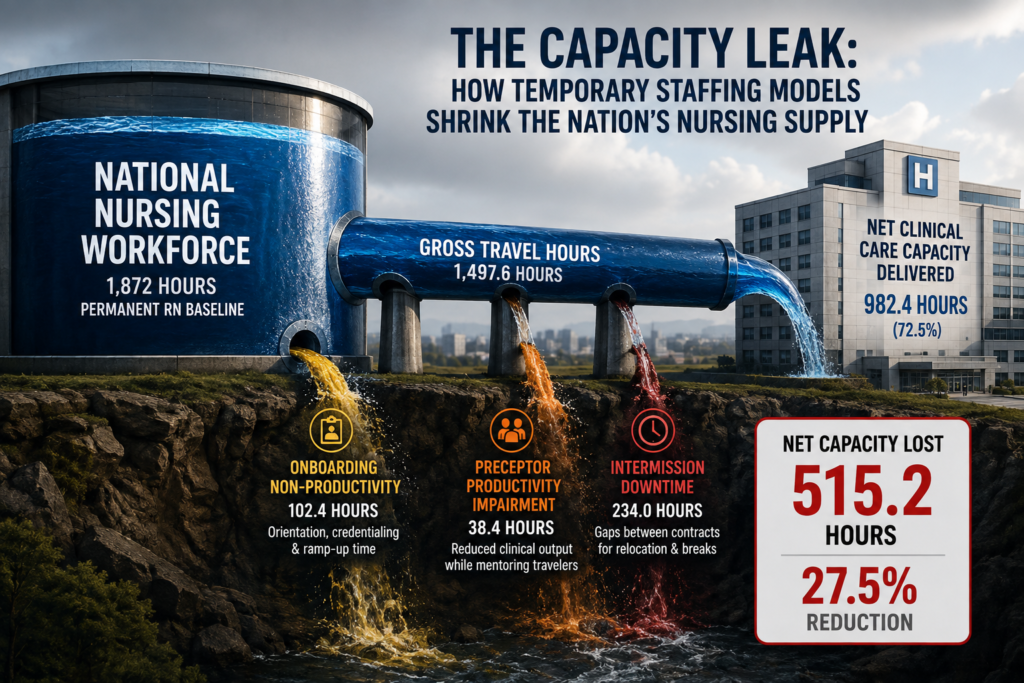
Converting permanent full-time equivalent positions into contingent agency labor creates severe Frictional Capacity Drag. This systemic drag eliminates 515.2 net clinical care hours per position annually, representing a 27.5% capacity reduction that actively contracts the total available national bedside nursing supply.
The Productivity Gap: Benchmarking Permanent Output vs. Contingent Routines
Agency nurses are just as qualified and can be as effective as permanent staff. Regardless, establishing the baseline operational metrics that govern bedside clinician routines reveals a stark productivity contrast between core staff continuity and contingent labor fragmentation.
Full-Time Permanent Productivity (The 1.0 FTE Benchmark)
A standard full-time permanent registered nurse (RN) in an acute care or skilled nursing facility provides a stable, predictable foundation of bedside clinical capacity. Scheduled for standard 36-hour workweeks across 52 weeks, a core 1.0 FTE nurse accrues 1,872 gross scheduled hours annually. This continuous scheduling structure allows health systems to build reliable unit shift patterns and maintain stable nurse-to-patient staffing ratios.
Accounting for standard distributed paid time off (PTO), statutory holidays, and mandatory continuing education, a permanent nurse utilizes approximately 120 to 160 non-productive paid hours annually. Consequently, a single core FTE yields between 1,712 and 1,752 net productive patient care hours per year.
This operational baseline translates into a high annual yield efficiency. Full-time core staff convert 82.5% to 86.1% of their gross paid annual time into direct, hands-on patient care at the bedside. Because paid leave is distributed across the calendar year while the clinician remains anchored to the facility roster, unit managers can plan shift coverage seamlessly without recurring onboarding delays.
Travel Agency Nurse Productivity: Intermissions and Unworked Contract Downtime
Contingent travel nurses operate under temporary assignments, predominantly structured around 13-week contract cycles. According to SIA benchmarking data and the National Association of Travel Healthcare Organizations (NATHO), active travel nurses complete an average of 3.2 to 3.5 contracts per year. At 36 billable hours per week, an active travel nurse generates between 1,497.6 and 1,638 gross billable hours annually.
Unlike permanent employees who take short, distributed leave while maintaining active employment, travel nurses take extended, deliberate intermissions between contract assignments. Industry studies show that travel nurses average 4 to 12 weeks of unworked downtime annually. This gap time is utilized for geographic relocation, credential processing, personal leave, and burnout mitigation following intensive assignments.
Such a structural downtime creates a severe baseline capacity gap. Over a 12-month period, converting a continuous FTE schedule to consecutive travel contracts removes 234 to 374 gross operational care hours per clinician position. Consequently, the annual bedside yield efficiency of a travel nurse drops to 70.2%–78.5%, delivering 12% to 20% fewer net clinical care hours than a permanent employee over the same timeframe.
Per Diem Agency Nurse Productivity: Schedule Fragmentation and Availability Limits
Lastly, local per diem staffing and shift-matching platforms offer localized flexibility but fail to establish guaranteed annual care capacity. Per diem schedules are inherently fragmented, relying on voluntary shift bidding and real-time clinician availability. This structure prevents health systems from building cumulative unit continuity or securing long-term coverage for complex medical floors.
Furthermore, per diem workforce models are subject to extreme shift cancellation volatility driven by fluctuating patient census drops and scheduling lag. When census drops occur, per diem shifts are cancelled first, creating income instability for clinicians and unpredictable shift coverage for facilities. When patient volume spikes suddenly, per diem availability frequently falls short of facility demand.
This mode of scheduling fragmentation places a heavy administrative burden on nurse managers, who must continuously schedule, verify, and fill open shifts on a daily basis. While per diem labor provides useful emergency coverage, it cannot deliver the sustained annual clinical output required to stabilize floor operations or replace full-time bedside staff.
The Facility Drain: Orientation Taxes, Preceptor Loss, and Core Burnout
As shown, both types of agency nurses tend to work significantly fewer hours. However, the time spent at full productivity is even significantly lower, even when assuming parity with FTE in terms of hours worked. Assimilating temporary personnel inside facility walls imposes substantial operational friction, consuming onboarding non-productivity and impairing core staff clinical yield.
The Financial Premium and Cost Recap
Health systems pay escalating financial premiums for temporary contract labor while receiving substantially fewer net patient care hours. We already discussed that national staffing benchmarks establish that agency nurse bill rates are more expensive. A single 12-hour travel nurse shift costs a facility between $1,077 and $1,125, compared to $669 for an equivalent permanent staff shift. A detailed analysis of how much healthcare staffing agencies cost demonstrates that health systems pay 1.68x to 1.91x more per shift for temporary labor while absorbing reduced clinician availability.
The financial drain from facilities in paying for the higher hourly rates lands squarely on the agencies. The agency administrative markups and gross margins, which range from 19% to 21%, extract substantial operating capital out of healthcare facilities. This capital extraction does not improve clinician compensation or floor staffing ratios; instead, it diverts funds away from core staff retention and permanent workforce investments. However, the loss incurred by healthcare systems goes beyond financial resources.
The Orientation Tax and Preceptor Productivity Loss
There is operational friction during the assimilation of temporary agency nurses that begins during the first week of every assignment. As detailed in published orientation research, each 13-week travel contract consumes 12 to 36 hours of non-productive onboarding, encompassing electronic health record (EHR) training, facility safety compliance, and unit workflow walk-throughs. This “orientation tax” absorbs 2.5% to 7.7% of total contracted billable hours per assignment.
The operational drag extends directly to permanent core staff assigned to precept incoming temporary nurses. Findings from travel agency nurse onboarding studies demonstrate that during orientation shifts, a core preceptor experiences a 30% to 50% drop in direct clinical productivity. Preceptors must balance direct patient care against continuous supervision, double-charting verification, and workflow guidance.
Assigning a core staff nurse to precept a temporary agency nurse for two 12-hour shifts results in a total loss of 7.2 to 12 hours of core staff clinical care output per contract. Annualized across 3.2 contracts per year, this preceptor drag eliminates an additional 23.0 to 38.4 hours of core staff care capacity per travel FTE position, further compounding unit productivity losses. Worse still, the impact of agency staffing extends beyond mere reductions in productivity for permanent staff.
The “Ripple Effect” on Core Staff Retention
Perpetual onboarding requirements and perceived pay differentials exert a corrosive effect on core staff morale. Experienced permanent nurses forced into continuous preceptorship experience severe cognitive fatigue and frustration from repeatedly training temporary colleagues who earn more only to depart after 13 weeks. This operational dynamic is known as the Ripple Effect.
Longitudinal health workforce studies on travel nurse burnout confirm that high agency utilization correlates directly with a 7.7% increase in permanent registered nurse turnover. Core staff members observe temporary colleagues earning higher nominal pay packages while carrying zero institutional committee burdens, accelerating burnout and triggering secondary core resignations.
The financial fallout of secondary turnover is catastrophic. Evaluating the anatomy of a clinician turnover shows that replacing a single bedside registered nurse costs $60,090 to $61,110 in direct recruitment, onboarding, and preceptor costs. For an average facility, every 1% increase in nurse turnover creates an annual bottom-line loss of $295,000, establishing a self-reinforcing cycle of core vacancy and agency dependency. Worse, still, the damage is not restricted to individual facilities.
The National Supply Contraction: Macro Capacity Loss and Patient Impact
Combining clinician downtime, onboarding non-productivity, and preceptor drag into a macroeconomic capacity equation proves that contingent staffing actively contracts the national bedside workforce.
Aggregate Time Loss: Quantifying Systemic Frictional Capacity Drag
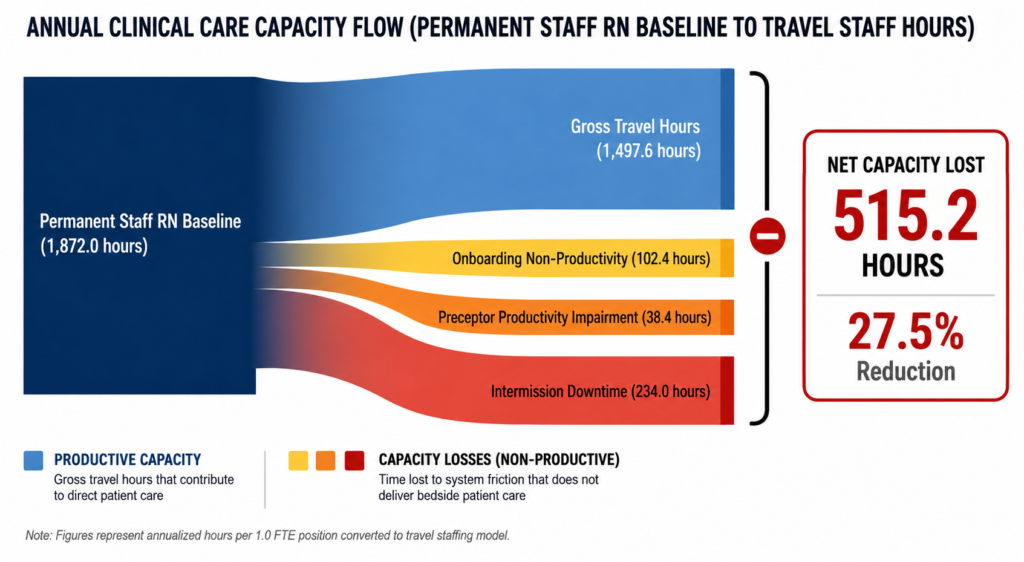
Integrating the highlighted productivity variables into a unified model quantifies the total net clinical care capacity lost when a health system converts a permanent full-time position to a travel nurse model. The formula for Frictional Capacity Drag is defined as:
Frictional Capacity Drag = Permanent Net Hours – (Travel Billable Hours – Onboarding Hours – Preceptor Hours Lost)
Where Permanent Net Hours represents baseline productive permanent time (1,872 scheduled hours baseline), Travel Billable Hours represents gross travel hours (1,497.6 hours across 3.2 contracts), Onboarding Hours represents non-productive orientation time (102.4 hours annually), and Preceptor Hours Lost represents core preceptor care capacity lost (38.4 hours annually).
Substituting empirical data points into the equation yields the following capacity calculation:
Frictional Capacity Drag = 1,872 – (1,497.6 – 102.4 – 38.4) = 515.2 hours lost per FTE per year
Geographic “Nurse Shuffling” and Clinical Disruption: Culture Shock and Patient Impact in LTC
Sourcing temporary labor in the form of travel agency nurses across distant regional markets merely redistributes an existing, static pool of clinicians. Research evaluating supplemental nurse staffing proves that shuffling an agency nurse from a Midwestern market into an Upstate New York facility does not add a single net-new clinician to the national workforce; it merely charges health systems a reallocation premium to move existing labor across state lines.
This geographic shuffling introduces severe institutional culture shock and regional workflow friction. Clinicians relocated to unfamiliar facilities encounter unfamiliar EHR setups, unfamiliar physician standing orders, and distinct regional patient population dynamics. In fast-paced acute care and complex skilled nursing environments, adapting to local facility norms requires weeks, during which care delivery efficiency suffers.
The clinical fallout of broken care continuity directly harms vulnerable patients, particularly in long-term care (LTC) and skilled nursing facilities (SNF). Empirical studies published in AJMC clinical studies reveal that high agency reliance in LTC settings correlates with a 6.44% increase in hospital-acquired pressure injuries, higher medication administration errors, degraded HCAHPS scores, and lower CMS Star Ratings. Shuffling clinicians across zip codes creates an illusion of flexibility while destabilizing resident care plans and safety-net facility operations.
Reclaiming Net Clinical Hours: Strategic Pivots to Workforce Stability
To eliminate frictional capacity drag, health systems must transition from reactive agency nurse procurement to permanent workforce stabilization. The primary strategic mechanism for recovering lost bedside hours is executing permanent travel nurse conversions. Converting high-performing travel agency nurses who are already acclimated to the floor into permanent employees instantly recovers the 515.2 lost care hours per clinician, stops contract churn, and eliminates third-party agency markups.
Furthermore, healthcare executives must overcome the misconception that buyout penalties make conversions unviable. Evaluating the financial math behind nursing agency conversion fee fallacies proves that paying an upfront conversion fee is demonstrably cheaper than absorbing continuous $90 per hour agency bill rates and recurring preceptor drag over a 12-month period.
Health systems can further stabilize operations by establishing enterprise internal float pools and adopting relational healthcare staffing models. Internal float pools offer clinicians competitive wage premiums and scheduling flexibility while standardizing EHR workflows and eliminating third-party agency tolls. Reclaiming lost clinical care hours restores floor stability, protects core staff morale, and secures long-term operating margins without increasing total headcounts.
Conclusion
Relying on temporary staffing and agency nurses is not a neutral operational choice; it actively contracts the national nursing pool by destroying 27.5% of productive bedside care hours per converted position. The 515.2 annual care hours lost to intermission downtime, onboarding taxes, and preceptor drag represent an unsustainable drain on healthcare system capacity.
Healthcare executives can systematically reclaim these lost clinical hours, eliminate agency markups, and restore unit stability. To evaluate your facility’s frictional capacity drag and engineer long-term workforce stability through permanent staff conversions, contact Nava Healthcare Recruitment for an executive workforce consultation.