
Agency nursing solved a problem no other staffing model could solve quickly. When an intensive care unit is forced to leave beds empty and decline emergency transfers because of being short-staffed, a per diem or 13-week contract from an agency is the difference between inadequate coverage and providing life-saving care for vulnerable patients. Facilities pay a premium for that speed, and for years the premium was the whole argument.
An agency invoice has never been the full cost of agency staff use. A permanent nurse is scheduled for 1,872 hours a year. A contingent clinician is scheduled for fewer hours, then loses more to orientation and acclimation, while their preceptor loses hours in guiding and supervising the new clinician’s work. The gap between hours scheduled and hours delivered is the one number that has never appeared on an invoice.
From Emergency Cover to Permanent Infrastructure
Before 2020, contract labour was a marginal operational buffer. Health systems used agencies to cover absences, parental leave, and predictable seasonal volume, and the spend sat at 2% to 4% of the labour budget at $55 to $65 an hour. The agency was a convenience, and the facility decided when to use it. They solved a scheduling gap that a facility could name, price, and close.
COVID changed both the category and the price. Contingent labour became a primary, high-cost operational necessity and bill rates reached $120 to $132 an hour at the 2021-22 peak, with contract labour running 12% to 20% of the workforce. Sure, the rates came down. Current bill rates are $75 to $95 an hour, and their share of the labour budget is 5% to 8%. What did not come down was the dependence. The research is explicit that spending “remains structurally elevated relative to pre-pandemic baselines, permanently altering hospital cost structures and workforce planning strategies”. The industry recalibrated; it did not revert.
Entrenchment came with consolidation. Five firms now control roughly 40% of a $39B to $47,3B market, and Aya Healthcare’s $615M acquisition of Cross Country in December 2024 gave it close to 25% of the travel nursing segment. The lock-in is structural: agencies “maintain a vertical monopoly by providing both the staff and the VMS platform used to hire them”, and 74% of contract volume now runs through those managed service and vendor management layers. The company that supplies the clinician also supplies the software that decides which agency supplies the clinician.
Then there are the financial incentives. Agency clinicians earn 20% to 30% more than permanent core staff, and the permanent post that cannot match that differential is where good nurses are lost. The documented effect is a loss of the middle. One analysis describes “an exodus not of nurses at the end of their careers, but of experienced, mid-career professionals”, and the share of registered permanent nurses holding ten or fewer years of licensure rose from 31% in 2020 to 38% in 2022. California hospital employee turnover reached 36% in 2023, up from 25% in 2019, and the research describes the result as a self-reinforcing cycle where turnover necessitates agency use, which in turn fuels further dissatisfaction among permanent staff.
Set the financial and experience or leadership loss questions aside, and a harder one remains: what have these contracts done to the national supply of bedside hours?
Capacity Measured in Hours, Not in Headcount
Every staffing decision in healthcare gets counted in people. A vacancy is one position, a contract is one clinician, a roster is individual names against a required ratio. Those counts are how invoices are read, not a measurement of care delivered. Against a permanent nurse’s 1,686 net productive hours a year, four frictions separate a contingent clinician from the same output.
1. The Travel Nurse: 576 Hours That Are Never Worked
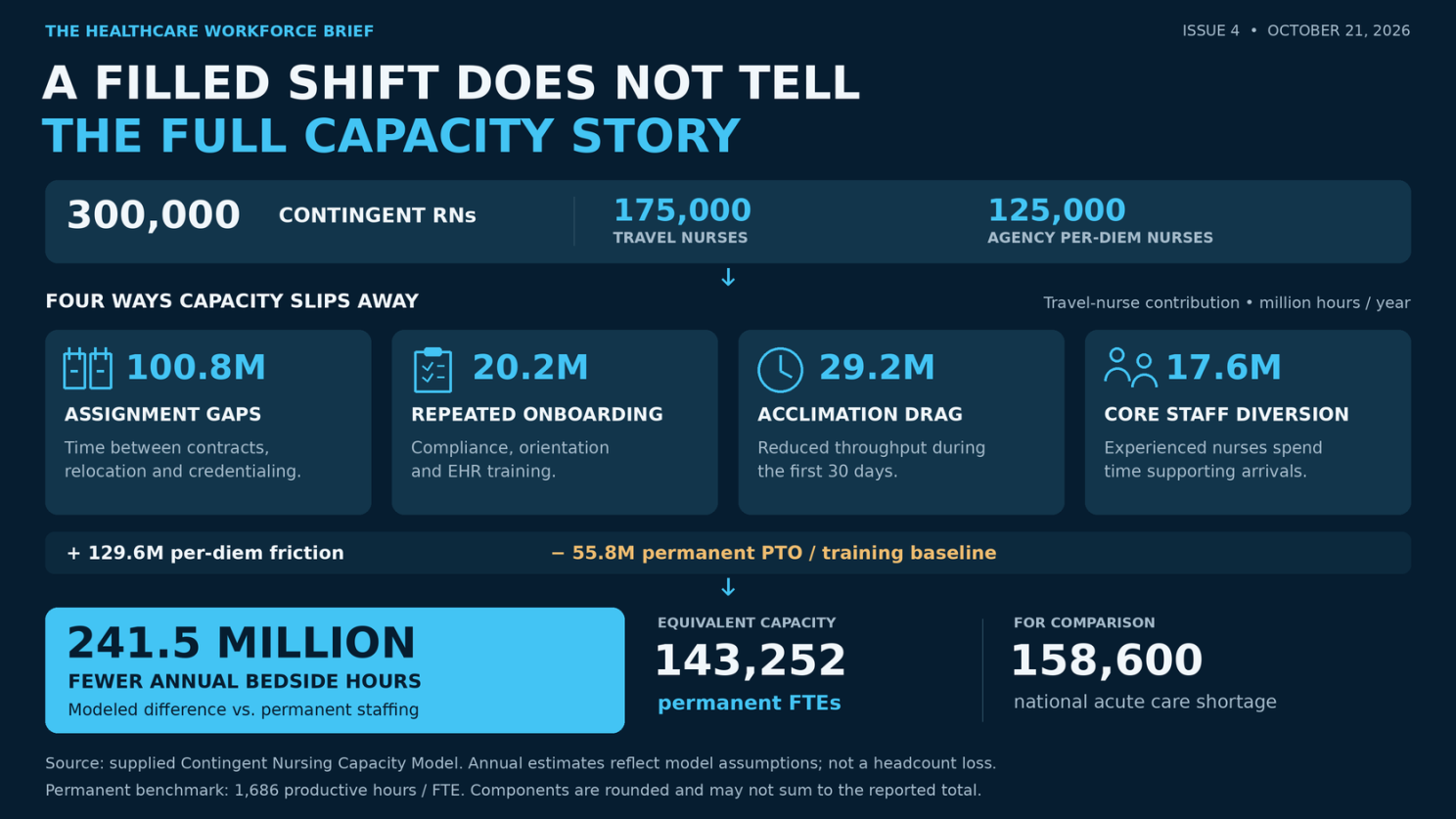
A travel nurse works 36 weeks a year. The other 16 are unworked time between contracts, relocation, and credentialing: 576 hours less when compared to the permanent schedule. Three more deductions apply. Every placement carries 32 non-productive hours of electronic health record training and compliance, so a nurse working 3.6 placements a year loses 115.2 hours that way. Productivity runs at a 30% discount for the first 30 days of each contract, costing 166.6 hours across the year. And the permanent nurses orienting the traveler spend 28 hours per placement, diverting 100.8 hours of their own clinical time. The net yield is 913.4 hours against 1,686, a difference of 772.6 hours of bedside care per travel FTE every year.
2. The Per-Diem Nurse: More Capacity Lost Per Head
Per-diem clinicians work fewer hours and lose more. A per-diem nurse averages 22 hours a week over 46 weeks, or 1,012 hours, leaving 860 hours of unworked capacity against the permanent schedule. Orientation runs 20 hours across 2.5 facilities a year. A 15% productivity discount across half of assigned shifts costs 75.9 hours. And the charge nurse and unit buddy supporting that clinician lose 50.6 hours. The net yield is 835.5 hours against 1,686, a difference of 850.5 hours per FTE. The per diem tier costs less and removes more of what the facility is actually buying.
3. The National Total: 241.5 Million Hours
Applied to the 300,000 contingent registered nurses in the United States, 175,000 travel and 125,000 agency per diem, the like-for-like model produces a national difference of 241,522,575 fewer bedside care hours a year. For context, against the permanent benchmark, that is 143,252 full-time equivalent clinicians lost in unproductive hours per year. This is when taking productive output into account, rather than counting clinicians removed from practice, and its calculation is rooted in peer-reviewed primary research. The national RN shortage stands at 158,600, and the capacity agencies remove is equivalent to 90% of it.
4. The Training Pipeline That Cannot Replace It
Most clinicians pulled into agency contracts are not near the end of their careers. 62% of travel nurses sit in the three-to-ten-year experience band, and 122,500 have five or more years in acute care. That tenure and experience are what make someone eligible to precept. However, 267,250 experienced contingent nurses across both pools, who otherwise would have been eligible preceptors, are currently ineligible because state boards, accrediting bodies, and hospital bylaws prohibit them from precepting.
Assuming that just 35% of eligible candidates take up preceptorship, averaging 2.5 students each, this represents 233,844 student placement slots a year lost in contingent clinicians. That is more than double the 93,176 qualified applicants nursing schools turned away in 2025. The staff pulled to agency work are the staff who would have trained the cohort that replaces them. Worse still, they represent a loss of leadership since, for good reason, policies systematically prohibit temporary nurses from serving as Charge Nurses, Code Team Captains, Rapid Response leads, or ED triage coordinators. Hundreds of thousands of experienced clinicians are confined strictly to basic task execution.
The Loss Compounds Where No One Is Measuring
On a facility level, the productivity loss through contingent staffing is manageable, and that is the problem. No facility experiences a national capacity contraction. It experiences a filled shift, a nurse who takes a few weeks to reach full speed, and a preceptor who is behind on documentation. Hospital financial statements (P&Ls, general ledgers, operating reports) are built to track dollars and headcounts, not delivered clinical yield.
Furthermore, the capacity that agencies remove also does not come back. A facility using agency coverage is not borrowing a clinician from a current or future surplus. It is drawing down a national pool with no mechanism to refill it on the same terms. Worse, the training pipeline required to refill that pool depends on the very experienced clinicians who are now cycling through per diem and 13-week contracts. The commercial staffing model profits by keeping nurses in motion while hospital resilience depends on anchoring them.
What Healthcare Leaders Can Measure Instead
None of this requires a facility to stop using agencies. It requires a different measurement, and three decisions that follow from it. Agency staff can consume 10% to 15% of total nursing labor expenditure while delivering only 5% to 8% of total hours per patient day, and that ratio stays invisible until someone calculates it.
- Reallocate the hidden friction premium back to core staff. When you divide invoice spend by actual bedside hours delivered, cycling travelers costs more than double the permanent baseline. Use that documented spread to justify immediate investments in internal retention, such as dedicated hourly preceptor stipends and clinical ladder bonuses that keep experienced nurses from leaving.
- Treat the 13-week contract as a paid evaluation, not recurring coverage. A traveler who has logged 32 hours of EHR onboarding and 28 hours of preceptor supervision is an already-vetted, fully integrated clinician. When unit managers want to keep a high-performing traveler, finance often rejects the agency buyout fee without realizing that letting that clinician leave means paying the exact same 60-hour orientation tax on their replacement tomorrow. Use 13-week contracts deliberately as extended probationary trials: when a clinician proves their clinical fit, converting them directly captures the onboarding investment you have already made.
- Build the flex layer internally. Internal float pools give clinicians schedule flexibility without commercial markups or repeated orientation, and they retain the institutional knowledge that high temporary staffing ratios erode. This is the layer that can absorb a census spike without eroding continuity of care.
For the full model and the underlying research, read the complete analysis in the Nava Healthcare Recruitment archive: Beyond Bill Rates: How Agency Nurse Staffing Models Shrink the National Nursing Supply
If the United States restricted the agency nursing industry, would the clinicians returning to permanent staffing outweigh the contingent coverage facilities would lose?