
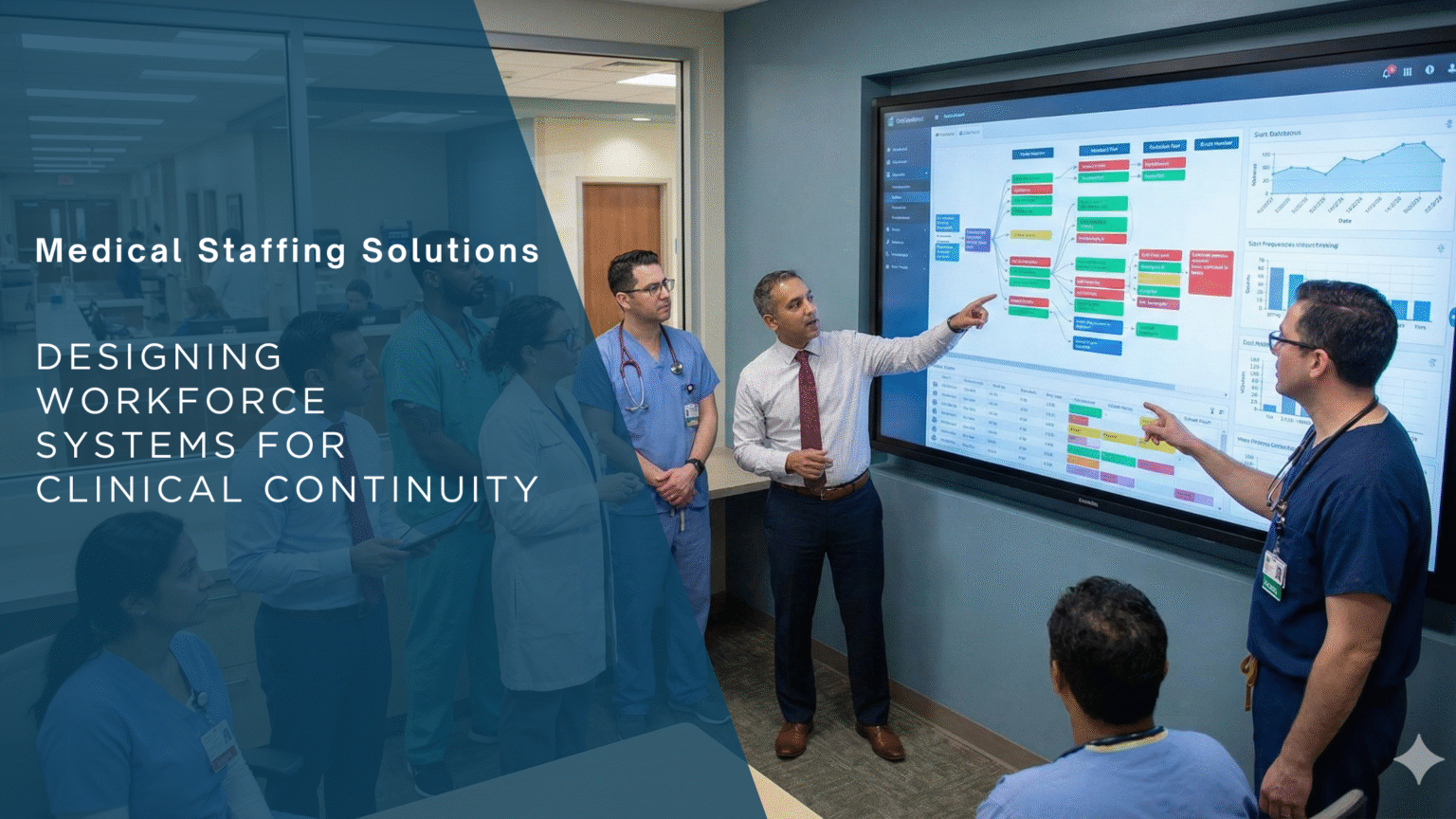
Medical Staffing Solutions: Designing Workforce Systems for Clinical Continuity
Medical staffing is often approached as a hiring challenge. In practice, it is a systems design problem that sits at the center of clinical quality, regulatory compliance, financial stability, and long-term access to care. As workforce shortages persist across multiple clinical disciplines, facilities are being forced to move beyond reactive hiring and toward structured staffing architecture.
Medical staffing solutions refer to the coordinated frameworks that allow healthcare organizations to sustain operations under fluctuating workforce conditions. These frameworks integrate workforce forecasting, credentialing infrastructure, deployment logistics, regulatory alignment, and financial exposure control. When properly engineered, they allow care delivery to remain stable even when labor markets remain volatile.
The Structural Forces Reshaping Medical Staffing
Today’s staffing instability is not driven by a single factor. It reflects the convergence of long-term structural pressures across the healthcare system.
According to the State of the U.S. Health Care Workforce, 2024 report from HRSA, more than 75 million Americans currently live in primary care Health Professional Shortage Areas, and 58 million lack adequate access to dental providers. Workforce modeling from the same report projects widening personnel gaps across multiple clinical roles through the 2030s, particularly in non-metro regions.
Clinician burnout, early retirements, and geographic maldistribution continue to constrain labor availability. The NIHCM Foundation’s analysis of healthcare workforce shortages documents how demand for services continues to rise faster than workforce supply across hospital, outpatient, and long-term care environments. Behavioral health, skilled nursing, rural health, and primary care remain especially vulnerable.
These workforce pressures are unfolding alongside rising regulatory oversight tied directly to staffing adequacy. Minimum coverage thresholds, documentation standards, and patient safety expectations are increasingly embedded in enforcement and reimbursement structures. As a result, medical staffing is no longer an administrative variable. It has become a regulated clinical dependency.
Medical staffing solutions exist to stabilize care delivery inside this permanent volatility.
What Medical Staffing Solutions Operationally Include
In operational terms, staffing solutions are not defined by any single hiring method. They encompass five tightly interdependent systems:
- Workforce access across clinical and support roles
- Credentialing and licensure verification
- Deployment and scheduling logistics
- Financial exposure and cost distribution
- Continuity and quality preservation
Facilities that underintegrate any one of these domains often experience downstream instability in the others. Rapid hiring without credential infrastructure increases compliance risk. Cost control without deployment flexibility increases care disruption. Continuity without surge capacity increases burnout and turnover.
Medical staffing solutions function by aligning all five systems simultaneously.
Medical Staffing as a Clinical Risk Variable
Understaffing is no longer viewed solely as a capacity issue. It is now a recognized driver of clinical risk.
Breakdowns in staffing systems correlate with higher rates of adverse events, medication errors, delayed procedures, and documentation gaps. Survey activity increasingly traces patient safety findings to sustained staffing deficits. The NIHCM workforce brief on healthcare workforce shortages highlights how staffing limitations directly affect throughput, quality, and continuity in high-demand care environments.
From a governance perspective, staffing adequacy now operates as a form of clinical risk management. It directly influences malpractice exposure, accreditation outcomes, quality benchmarking, and regulatory enforcement.
This risk lens becomes critical when evaluating temporary vs. permanent healthcare staffing decisions across clinical units.
Workforce Architecture as an Operating Framework
Rather than classifying staffing strictly as temporary or permanent, many organizations now design staffing as a layered operating framework.
Core Clinical Infrastructure
This layer consists of permanent physicians, nurses, and essential support staff who anchor quality programs, infection control, documentation integrity, and institutional knowledge.
Variable Capacity Layer
This layer absorbs census swings, seasonal demand, extended leave, and program surges. It is typically composed of per-diem clinicians, short-term contracts, or time-limited placements deployed for coverage flexibility rather than institutional permanence.
Specialty and Access Layer
Certain clinical roles are too scarce or low-volume to support through full-time internal hiring alone. This layer supports specialty access without permanent payroll exposure.
When these three layers are engineered in coordination, facilities gain flexibility without sacrificing quality. When they operate in isolation, instability increases.
The Financial Reality Behind Staffing Decisions
Staffing cost is frequently reduced to wage or bill rate comparisons. In practice, the true financial exposure of staffing extends much further.
Facilities incur layered cost from vacancy-driven service loss, overtime escalation, recruitment churn, onboarding inefficiency, repeated credentialing, compliance failure remediation, and burnout-driven turnover. The NIHCM’s analysis of workforce cost pressures and vacancy exposure outlines how vacancy and overtime dependence are now among the fastest-growing cost drivers for healthcare providers nationwide.
Medical staffing solutions help distribute this exposure across multiple workforce inputs rather than concentrating it in a single fragile hiring pipeline. Financial predictability improves when no single staffing mechanism bears the full burden of volatility.
Why Long-Term Care and Skilled Nursing Require a Distinct Staffing Architecture
Long-term care and skilled nursing environments operate under uniquely rigid staffing regulation tied directly to daily census and resident acuity. The CMS minimum staffing standards for long-term care facilities establish explicit requirements for total nursing hours per resident day, minimum nurse aide and RN coverage, and continuous on-site RN presence.
These rules convert what might otherwise be flexible scheduling decisions into enforceable clinical thresholds. The final CMS staffing rule enforcement framework further clarifies how compliance will be assessed through inspection and survey mechanisms.
In these settings, staffing volatility immediately translates into regulatory exposure. Census changes alone can tip a facility into non-compliance if workforce infrastructure cannot adjust in real time.
For this reason, staffing solutions in long-term care function simultaneously as a workforce mechanism and a compliance shield.
Learn more about Medical Staffing Solutions for Skilled Nursing Facilities
External Staffing Infrastructure as System Extension
No facility can internally sustain full workforce coverage across every role during every operational condition. External staffing infrastructure exists to extend internal workforce systems during periods of stress.
The value of these external systems is not limited to speed of fill. Their primary function is to expand workforce liquidity, compress time to coverage, absorb credentialing and regulatory burden, preserve service continuity when internal pipelines fragment, and buffer revenue loss driven by prolonged vacancy.
When integrated strategically rather than reactively, external staffing becomes an extension of internal workforce governance instead of a last-minute patch.
Medical Staffing Solutions as a Long-Term Operating Discipline
Facilities that treat staffing as episodic recruitment remain perpetually reactive. Facilities that treat staffing as an engineered discipline operate with predictable surge response, reduced compliance volatility, moderated labor inflation, lower turnover pressure, and stronger service line durability.
Medical staffing solutions formalize this discipline, transforming workforce uncertainty into a managed operational variable instead of an existential threat to care delivery.
Medical Staffing Solutions FAQs
What are medical staffing solutions in operational terms?
They are the integrated systems used to secure, deploy, regulate, and sustain a workforce across permanent, variable, and specialty layers while preserving compliance, financial control, and care continuity. Learn about Nava Healthcare’s medical staffing solutions.
Why is staffing now viewed as a compliance issue?
Because staffing adequacy directly affects patient safety, survey outcomes, accreditation status, and legal exposure. CMS staffing rules now directly link workforce levels to regulatory enforcement. reduce turnover by more than one-third. Learn more.
Is temporary staffing only a short-term fix?
In mature systems, temporary staffing functions as a planned capacity layer rather than emergency response. Learn about Reclaimix™ by Nava Healthcare helping you turn agency reliance into long-term stability.
Why is staffing especially complex in long-term care?
Because census and acuity directly dictate required coverage thresholds that must be maintained continuously under CMS rules.
What role does credentialing play in healthcare staffing?
Credentialing ensures every healthcare professional meets licensing and training standards. The Joint Commission emphasizes that automated credential management reduces onboarding time by 40 percent and lowers compliance risk.
How do staffing solutions reduce financial volatility?
They distribute vacancy risk, control overtime escalation, minimize service interruption, and stabilize cost exposure across multiple workforce channels.