
If your health system authorized an expanded recruitment budget this quarter, you are not alone. Across the country, hospital executive committees are approving record sign-on incentives, increasing contingent bill rates, and pushing talent acquisition teams to source faster. Yet bedside vacancy rates remain stubbornly locked at 8.6%, and one in three U.S. hospitals still grapples with vacancies exceeding 10%.
Hospital leaders are responding to the national clinician skill shortage using escalating sign-on bonuses as a survival tactic to keep critical units staffed. When combined with the emergence and over-reliance on travel nursing, the industry has essentially created a bidding war that is shuffling clinicians between facilities.
A Broken Pipeline, Not a Procurement Problem
The U.S. nursing shortage is not an aggregate labor shortage that can be solved with recruitment spending. It is an interlocking series of structural ceilings across domestic academic training, faculty compensation, federal statutory immigration caps, and transactional incentive design.
Each ceiling is governed by an entirely different mechanical bottleneck. When healthcare leaders treat this complex infrastructure as a standard procurement exercise, conventional tools, such as five-figure signing bonuses and elevated agency premiums, do not generate new clinical capacity. They merely bid up the price of a fixed, inelastic pool of clinicians while actively accelerating operating margin compression.
Four Mechanisms of Bedside Scarcity
The clinical labor deficit cannot adjust dynamically because three structural ceilings throttle new supply, while transactional hiring incentives actively accelerate turnover:
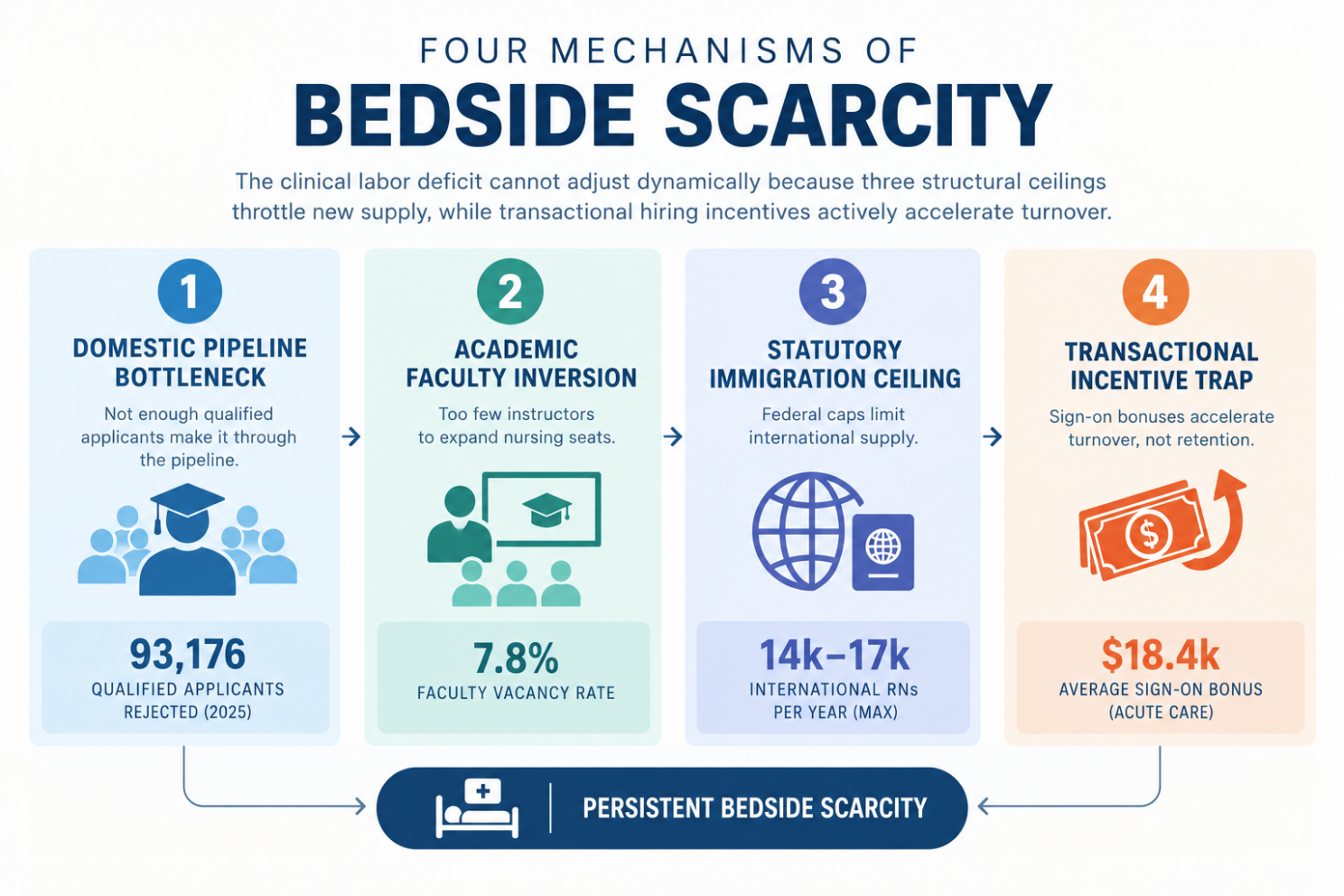
Ceiling #1: The Domestic Pipeline Bottleneck (Capacity vs. Demand)
The constraint on domestic nurse production is not student interest. Bachelor of Science in Nursing (BSN) enrollment grew 7.6% this past academic cycle. Yet in 2025, U.S. nursing schools turned away 93,176 qualified applications, including 75,255 rejected from entry-level BSN programs alone.
The barrier is physical: severe shortages of clinical placement sites, acute-care preceptor bandwidth, and accredited simulation capacity cap class sizes. Meanwhile, Bureau of Labor Statistics (BLS) projections show that of the 189,100 annual RN openings through 2034, 91.2% represent structural replacement positions (retirements, departures, and bedside exits) rather than expansion. The domestic training machinery cannot even replace the clinicians walking out the door.
Ceiling #2: The Academic Faculty Inversion
Even when funding exists to expand nursing seats, schools cannot hire instructors. The national full-time nurse faculty vacancy rate stands at 7.8%, with nearly 80% of open faculty lines requiring doctoral credentials.
The pipeline feeding these roles is drying up: enrollment in research-focused nursing PhD programs has declined for 11 consecutive years, dropping over 20% since 2013. Furthermore, the average age of doctorally prepared nursing professors is 61.2 years. A senior acute-care nurse with a BSN can earn $110,000 to $140,000 at the bedside, while a university assistant professor contract frequently tops out near $85,000. The market financially penalizes experienced clinicians who choose to train the next generation.
Ceiling #3: The Statutory Immigration Ceiling
Hospitals turning to international direct-hire recruitment to bridge short-term gaps face rigid federal statutory quotas:
- The EB-3 Statutory Brake: Professional nurses enter primarily via the EB-3 immigrant visa under the Schedule A labor certification bypass. However, EB-3 is globally capped at approximately 40,040 visas annually. Because family dependents consume over 50% of these numbers, the net principal cap across all worldwide industries is roughly 20,000.
- The Math: Even if healthcare captures 60% of all worldwide EB-3 principal visas (12,000 nurses) and combines them with uncapped Canadian/Mexican TN visas (4,000 to 5,000 nurses), total international supply caps at 14,000 to 17,000 RNs per year.
- The Reality: Against 189,100 annual openings, international channels can offset at most 7.4% to 9.0% of national vacancies. Sponsoring international talent provides stability to individual units, but federal quota retrogression (currently stretching wait times to 24–48 months) incurs $219,000 to $1.8 million in cumulative vacancy holding costs per bed while awaiting arrival.
The Financial Penalty and Unintended Consequences of Sign-on Bonuses
Faced with domestic and international supply ceilings, facilities default to escalating sign-on bonuses, now averaging $18,400 across acute care.
The math behind these upfront bounties is quietly devastating to operating margins. Econometric evaluations across more than 50 hospitals reveal that upfront $10,000+ signing bonuses generate a net 24-month retention rate of only 66.3%, compared to 61.0% for facilities offering zero bonuses.
Because a hospital cannot determine in advance which clinicians a bonus will actually influence, leadership must commit $1 million to give 100 nurses a $10,000 bonus just to retain 5 extra clinicians after 24 months.
Since 61 nurses would have stayed anyway and 34 leave regardless, $950,000 of that $1 million commitment produces zero incremental retention. The facility spends $1 million to secure 5 nurses, paying an effective $200,000 per retained clinician.
Meanwhile, nurses planning an exit simply bide their time until the bonus can no longer be legally clawed back. And for incumbent nurses who might otherwise remain settled, five-figure signing bonuses advertised down the street become an active invitation to resign.
The Mechanics of Scarcity
When health systems respond to structural scarcity with transactional procurement, their operational responses worsen unit stability.
First, sign-on bonuses and travel nurse premiums do not produce a single net-new nurse. They reallocate an inelastic supply of clinicians across municipal borders, extracting tens of thousands of dollars in administrative and agency markups while leaving aggregate regional capacity unchanged. Furthermore, they actually reduce net bedside hours (full-time equivalent), burning thousands of clinical hours in credentialing downtime and facility reorientation.
Second, this procurement approach destabilizes internal equity. Peer-reviewed research in Health Affairs (Ratliff et al., 2025) demonstrates that between 2012 and 2023, registered nurses experienced the lowest long-term real annual wage growth (0.51%) of all clinical cohorts, accumulating only 3.8% in real wage growth over an entire decade.
When incumbent nurses, the ones who have weathered a decade of real wage stagnation, watch lateral recruits receive $20,000 signing bonuses or temporary travelers make $90/hour on their same unit, the internal retention test fails. Resigning to become a traveler or lateral recruit becomes the only economically rational decision.
Strategic Leadership Shifts
Healthcare executives cannot solve a structural production bottleneck with transactional procurement tactics. Sustainable balance-sheet stability requires three leadership pivots:
- Restructure Incentive Capital Away From Upfront Bounties:
- Shift International Recruitment to a Rolling 36-Month Horizon:
- Reduce First-Year Attrition via Structured Residencies:
For an exhaustive investigation of the data, legislative constraints, and economic modeling behind these four supply ceilings, read the complete analysis in the Nava Healthcare Recruitment research archive:
Why the Supply Side Cannot Catch Up: The Four Mechanisms Driving the 2026 Nursing Shortage